2025 Projects
2025 Western Sustainable Impact Fund Projects
Water Sustainability
This project enhanced access to drinking water at large campus events by introducing three portable water stations. The new units supported Orientation Week and FanFest by providing reliable, on‑site hydration where permanent infrastructure was limited. The initiative strengthened Western’s commitment to student well‑being and sustainability by encouraging the use of reusable water solutions and improving the overall experience at high‑attendance outdoor activities.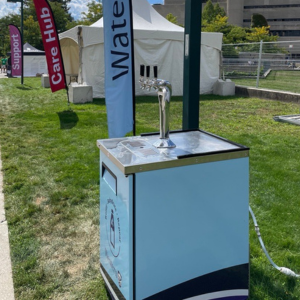
Wildlife surveys for the Biodiversity Inventory at Western
This faculty-led project through the Department of Biology aims to enhance a Campus as a Living Lab Project, the Biodiversity Inventory at Western. Nature walks for undergraduate students are offered where observations can be made for the Inventory. Participant experience will be enhanced and the ability to identify fast moving species, such as birds, will be improved.
Electric utility vehicle at Alumni Stadium
This staff-led project supported campus sustainability by introducing a new electric utility vehicle for use at Alumni Stadium. The vehicle replaced a gas‑powered model, reducing noise and emissions while improving day‑to‑day operational efficiency for staff and student employees. Its use during game days and athletic events strengthens Western’s commitment to cleaner energy solutions and contributed to a quieter, more environmentally responsible campus environment.
Solar powered picnic table with charging station
This research project led by Dr. Joshua Pearce developed a solar-powered charging picnic tables/stations where users can charge their laptops, cellphones, and even an E-bike. This table was made using 3D printers and an open source to press developed by Western Engineering.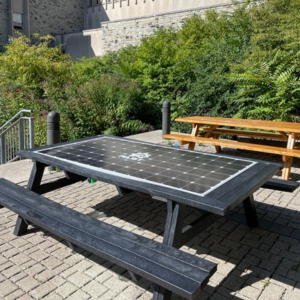
Wastewater Aquaponics
This research project through the Department of Chemical and Biochemical Engineering aims to create a fully autonomous and self-sustaining aquaponic system that utilizes wastewater effluent to create purified water that is suitable for drinking, fresh vegetables, and animal (fish) proteins.
From Waste to Win: Enhancing Campus Sports Turfs with Reclaimed Resources
This research project through the Department of Chemical and Biochemical Engineering aims to develop a sustainable approach to sports turf management at Western by harnessing campus wastewater as a resource. This project will develop and implement a decentralized treatment process to convert wastewater into reusable water and nutrient-rich byproducts that can enrich soil quality.
Mapping Digital Environmentalism through AI-based Arts
This student-led project through the Department of Gender, Sexuality, and Women's Studies aims to present a series of talks and insights to examine AI's role in reshaping environmental perception and promoting sustainable digital practices. A hybrid film & art festival will explore how emerging technologies such as AI and VR are transforming perception, storytelling, and our relationship to environmental realities through a wide range of digital media works.
Visit the project's website here.
Water Purification System
This project, led by staff in the Department of Biology, strengthened research capacity in the molecular genetics unit by introducing a new water purification system essential for high‑quality laboratory work. The upgraded system supported more efficient workflows and enhanced the reliability of molecular research, contributing to long‑term growth in productivity and innovation within the department. Its implementation advanced Western’s broader commitment to supporting cutting‑edge scientific research on campus.
Biochar Land Installation and Sustainable Art Exhibition
This project led by the Department of Visual Arts aims to install a biochar land art installation at Western's ICFAR. This interdisciplinary project will create an art piece made of biochar produced on Western's campus to bring attention to sustainability and soil health. In addition to the land art installation, this project will also host a community workshop on biochar, sustainability, and soil health in November 2025.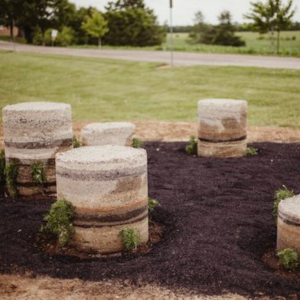
View the progress of the installation here!
Enabling active transportation through secure and sheltered bike-parking in the WIRB
This staff-led project will install wall racks in the Western Interdisciplinary Research Building (WIRB) bike room to increase usability of the space for community members who cycle to campus.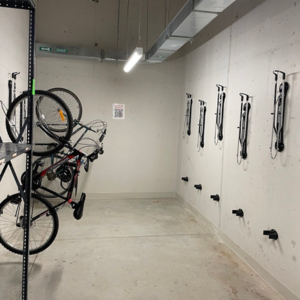
EnviroCon 2025 - Sharing Environmental Knowledge
EnviroCon is an interdisciplinary conference organized every year by graduate students in the Collaborative Specialization in Environment and Sustainability at the Centre for Environment and Sustainability at Western University. This one-day engagement event engaged the campus community to participate in to learn about sustainability-related topics.
Sustainable urban agriculture living lab
This research initiative through the Department of Geography and Environment's Sustainable Resource Management Lab supports a Campus as a Living Lab project that will examine management practices that support food security and improve water quality through urban green infrastructure. Additionally, this project will enhance access to growing space for Western community members.
Green transport for all: Cargo bike share
This faculty-led project aims to support active and sustainable transportation at Western by providing a bookable electric cargo bike. An E-cargo bike allows for bulky items to be transported across campus, increasing accessibility for those who don't have access to a motorized vehicle and reducing GHG emissions.
The cargo bike and trailer are available for students, staff, and faculty at Western. Book it here!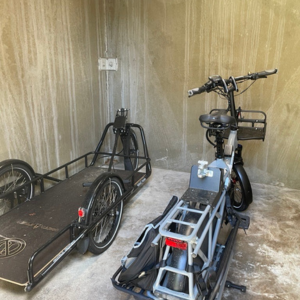
Food Sustainability Artist in Residence
This interdisciplinary research project aims to hire an artist in residence at the world's first Nootropics Food Lab to create a body of work documenting tenets of food sustainability, and improve community awareness.
Bike Repair Station at Western #2
This project builds off the first bike repair station that was supported by the WSIF. This bike repair station has been installed near the secure bike shelter (around the Rec Centre) to support cyclists on campus, and sustainable transportation.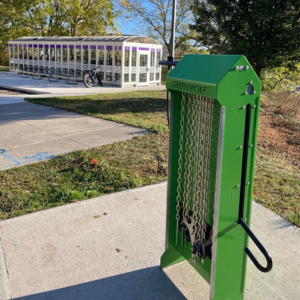
Echoes of Matter: Art in Deep Time and Ecological Memory
This interdisciplinary exhibition, workshop series, and zine will examine the lifecycle of matter across scales while fostering ecological consciousness and sustainable practices. Through the combination of art and education, this project will engage with community members on the concept of matter and ecological awareness.
London Moves: Sustainable Transportation Case Competition
The Western Transportation Engineering Club advanced sustainable mobility awareness on campus through the London Moves: Sustainable Transportation Case Competition. The event brought together students from engineering, business, and urban planning to develop innovative, data‑driven solutions to real‑world transportation challenges. It engaged more than 40 participants, strengthened interdisciplinary collaboration, and provided students with hands‑on learning, professional feedback, and networking opportunities with industry experts. The competition also showcased strong technical and presentation skills across teams, supporting Western’s commitment to sustainability education and community building in transportation innovation.
Diversity of Thought Series
This series is organized by the Ivey Degrowth Club, a student-led club at Western. This project aims to engage participants around sustainability, systems change, and alternative economic models. Numerous events will feature speakers, workshops, and collaborative discussions to challenge conventional business paradigms.
Geospatial Artificial Intelligence Workshop on Environmental Sustainability
The Department of Geography and Environment delivered a three‑part Geospatial Artificial Intelligence (GeoAI) workshop series that strengthened campus engagement in sustainability‑focused learning and innovation. The workshops brought together more than 100 students from diverse disciplines to explore how AI and spatial data can be applied to environmental challenges. Through expert‑led sessions, hands‑on training, and real‑world demonstrations, participants developed practical skills in machine learning, deep learning, and geospatial analysis. The series also deepened connections with community partners and elevated Western’s leadership in geospatial technology and sustainability education. The project gained national recognition when a GeoAI water‑quality modeling demonstration developed through the workshops was selected for presentation at the Esri Canada Research & Education Conference.
What are the bees up to? Exploring the foraging dynamics and hive activity of honeybees at Western University
This research project through the Department of Biology will classify and measure the pollen used by honeybee hives at Western, to develop a smart hive using an internet-of-things based sensor array that can live monitor the state of a hive and predict health changes, and to monitor the changes to gut microbiome in relation to resource utilization and behavioural changes. This project will support a current Campus as a Living Lab program.
A bird migration monitoring station at Environmental Sciences Western for biodiversity conservation training, education, and community outreach
This research through the Department of Psychology project is a continuation of a WSIF project that was supported last year. This project built on this work and operated a bird‑banding station at Environmental Sciences Western to support biodiversity research, hands‑on training, and community learning. Students and staff gained direct experience with bird handling and monitoring as part of Western’s migratory bird research. The station also welcomed campus and community visitors, strengthening outreach efforts and deepening public understanding of bird migration and conservation.
Sustainable Signage for artLAB Gallery in Department of Visual Arts
This project is led by staff in the Department of Visual Arts and will install indoor signage and wayfinding to the artLAB Gallery that is visually striking and made sustainably. This project is in collaboration with the Centre for Sustainable Curating, who has helped research materials that are recyclable, biodegradable, and plastic-free. A key part of this signage will highlight the Deshkan Ziibi that flows through campus, right behind the artLAB Gallery.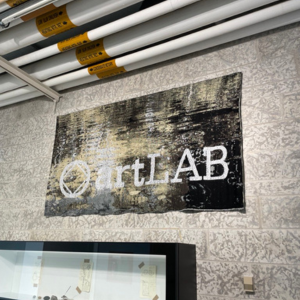
Community-facing RISOgraph Workshop and Connected Publication Series
This project is led by the Department of Visual Arts and will make use of an already existing piece of equipment in the Centre for Sustainable Curating, a RISOgraph. This equipment is used for economic and environmentally friendly printing and publishing. This project aims to organize a workshop with a RISO expert who will share different techniques of preparing files and printing. This will be the only eco-friendly RISO duplication service available in London and the surrounding region and a training workshop will increase access and support future research.
The Greenhouse Opens its Door to Western Community
This project strengthened sustainability learning and community engagement by opening the Western Greenhouse to students and campus partners. Through a series of hands‑on workshops, plant sales, and outreach events, FOGs connected students with plant care, native seed propagation, and urban biodiversity practices. Shade panels installed in the upper greenhouse supported long‑term energy reduction efforts, contributing to a more sustainable facility. The project also fostered new collaborations across campus groups and expanded volunteer opportunities, creating an accessible and educational space that encouraged students to engage with sustainability through horticulture and conservation‑focused activities.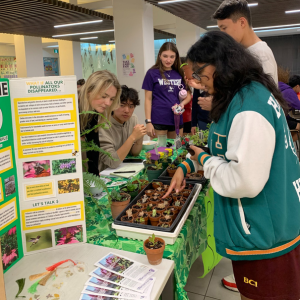
Learn more about this project here.
Biodiversity Collections and Biodiversity Gallery Enhancements
This project led by faculty in the Department of Biology aims to accomplish a few goals. Firstly, enhancing the Biodiversity Gallery through new specimens, new labels, education signage. Secondly, a pilot project to open the Gallery to the campus community for one afternoon, including an open house to celebrate the Gallery's 10th anniversary. Finally, new equipment for digitization of larger specimens. This project will improve the learning experience of Western students and visitors of the Biodiversity Gallery.
Art Thrive: Elemental Forces
Art Thrive: Elemental Forces is a social and creative space where connection and creativity is paramount. Through video art, moving images, and a unique and fun artistic activity led by local artists, each event celebrates an elemental theme- earth, wind, fire and water.
Take part in free drop-in events happening across various locations on campus.
This project is led collaboratively between the McIntosh Gallery and Wellness & Wellbeing.
Anabada Circular Market
This student-led project hosted a marketplace-style event to promote the concept of the circular economy in March 2025. The ANABADA Circular Market introduced Western students to circular economy principles through a full‑day campus event featuring sustainability‑focused vendors, a clothing exchange, and a book swap. The market welcomed more than 1,000 students and fostered over 560 meaningful interactions between students and local circular‑economy businesses. With strong participation and enthusiastic engagement, the event encouraged students to explore sustainable consumption practices and supported local vendors contributing to waste reduction initiatives.
Learn more here.
Green Embalming Pilot
This research project, led by faculty in the Department of Anatomy and Cell Biology, aims to examine the feasibility of transitioning from traditional embalming methods at Western's Anatomy Lab to a sustainable alternative called GreenMBalm. This project aims to eliminate the use of hazardous chemicals that contribute to environmental pollution. GreenMBalm is an ethanol-based preservative that is free of harmful chemicals. This pilot will test GreenMBalm on a subset of cadavers on campus over a 12-month period to determine the feasibility of the method and its suitability in teaching and research.
Anatomy Lab - Sustainability Assessment and Certification
This student-led project aims to make the Western Anatomy Lab the first lab campus to gain the My Green Labs certification. This program is a non-profit organization that works to improve the sustainability of scientific research. The program covers 14 different impact areas including infrastructure, cold storage, water, and resource management
Towards resilient and sustainable Western campus using smart sensing techology
This research project through the Department of Civil and Environmental Engineering builds on a Campus as a Living Lab project that is developing smart technology to improve the sustainability and resiliency of our society. This project will develop a campus-level urban scanning framework for tracking the infrastructure and environmental status of the campus. This research will help tackle problems including heavy traffic, pollution and climate change, and various other hazards.
WaterAid Sustainability Conference 2025
The WaterAid Sustainability Conference took place during Springfest 2025 and brought students together to learn about global and local water challenges through expert talks, hands‑on activities, and discussions on water filtration technologies, river conservation, and sustainable business practices. With around 60 participants, the conference sparked thoughtful dialogue, strengthened connections between students and environmental professionals, and equipped attendees with practical strategies for integrating sustainability into their daily lives. The event advanced awareness of water stewardship and inspired deeper student involvement in environmental initiatives across campus.
Learn more here.
Autonomous Delivery Drone
The Western Aero Design Team is designed and developed an electrically powered autonomous aircraft capable of performing precision payload delivery and retrieval missions. This project emphasizes lightweight and energy-efficient design principles, improving reliability and reducing operational footprints.
High performance, fire retardant and recyclable polymer biocomposite foam for a circular economy
This research project through the Department of Chemical and Biochemical Engineering is a continuation of a WSIF project that was supported in 2024. The 2025 project studied the role of recycled materials and various environmentally safe flame retardants in the polystyrene foam.
This project is in collaboration with a start-up company, ShivFreen Foam Insulations Ltd, which focused to capture the market opportunity by developing a sustainable, eco-friendly, recyclable and high-performance extruded foam.
Publications
USC Coat Cycle
This project is led collaboratively by the University Students' Council and EnviroUSC works to reduce textile waste and support students by giving unused lab coats a meaningful second life.
Learn more about this program through the USC's website.